

 3 Celts & Company • "THE IRISH TARTANS"
 Although not a traditional component of national dress outside Scotland, kilts have become recently popular in the other Celtic nations as a sign of Celtic identity. Kilts and tartans can therefore also be seen in Ireland, Wales, Cornwall, the Isle of Man, Brittany, Galicia in Spain, the Trás-os-Montes region in the North of Portugal, and Normandy, as well as parts of England, particularly the North East.
Though the origins of the Irish kilt continue to be a subject of debate, current evidence suggests that kilts originated in the Scottish Highlands and Isles and were adopted by Irish nationalists at the turn of the 20th century as a symbol of Celtic identity. A garment that has often been mistaken for kilts in early depictions is the Irish lein-croich, a long tunic traditionally made from solid colour cloth, with black, saffron and green being the most widely used colours. Solid coloured kilts were first adopted for use by Irish nationalists and thereafter by Irish regiments serving in the British Army, but they could often be seen in late 19th and early 20th century photos in Ireland especially at political and musical gatherings, as the kilt was re-adopted as a symbol of Gaelic nationalism in Ireland during this period.
Tartan was worn originally in Scotland as a fashionable type of dress. All tartan was, of course, hand woven and each weaver would take it upon him or herself to create unique and attractive designs based on the colors of dyes available. Certain colors may have been more common in certain regions, but there was nothing to prohibit someone with money from importing various dyes. Certain pattern schemes may have been more common in one area than another, but nothing approaching modern clan tartans could be said to have existed.
Imagine talking to a hand weaver of tartan, a craftsman and an artist, and telling that person that you wanted them to weave the same pattern of tartan in the same colors for everyone in the region (regiment, clan, etc.). That pattern was set in stone, could not be varied from and was to be the only pattern woven for that clan. Of course they would never have taken such commands! Tartan was and still is an art form and individual weavers created a wonderful variety of tartan designs.
By the 16th century, when we begin to see the earliest type of kilted garment (the belted plaid), tartan had become characteristic of Highland Dress. Gaelic speaking Highlanders wore tartan of bright and flashy shades to show off wealth and status. They also favored darker, natural tones that would emulate the shades of the bracken and the heather so that they might wrap themselves in their plaids and be hidden. But the colors chosen had more to do with what dyes were available to them (either locally or that they could afford to import) and personal taste than any clan affiliation.
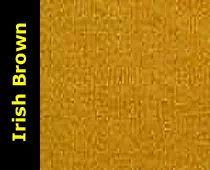
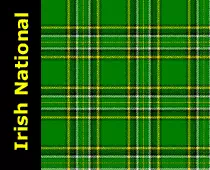
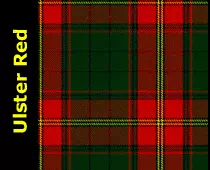
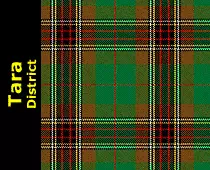
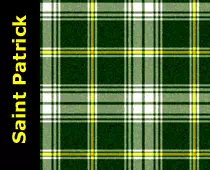
Irish Tartans: SAFFRON (Irish Brown), IRISH NATIONAL (Tara), ULSTER RED, SAINT PATRICK, IRISH BLACK, [url=https://www.3celts.com/index_files/menu_files/kilt_files/Tara-k.htm]Tara DISTRICT[/url]
"Kilt". Wikipedia. wiki Kilt . December 2013. web.
Newsome, Matthew. "The Early History of The Kilt". Scottish Tartans Museum. //albanach.org/kilt.html . [Archieved]. 2000. web.
The Scottish Register of Tartans (SRT). tartanDetails ref=4071 . 31 December 2018. web.
keywords[x] tartan, wool, kilts, Irish, Celtic, Gaelic, nationalism
Irish Unity Wool Kilt
Ulster Red Wool Kilt
Saint Patrick Wool Kilt

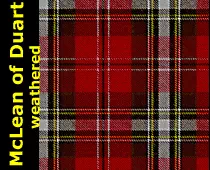
 3 Celts & Company • "MACLEAN"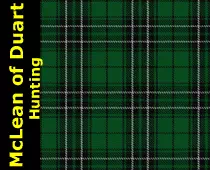
 "3 Celts & Company"